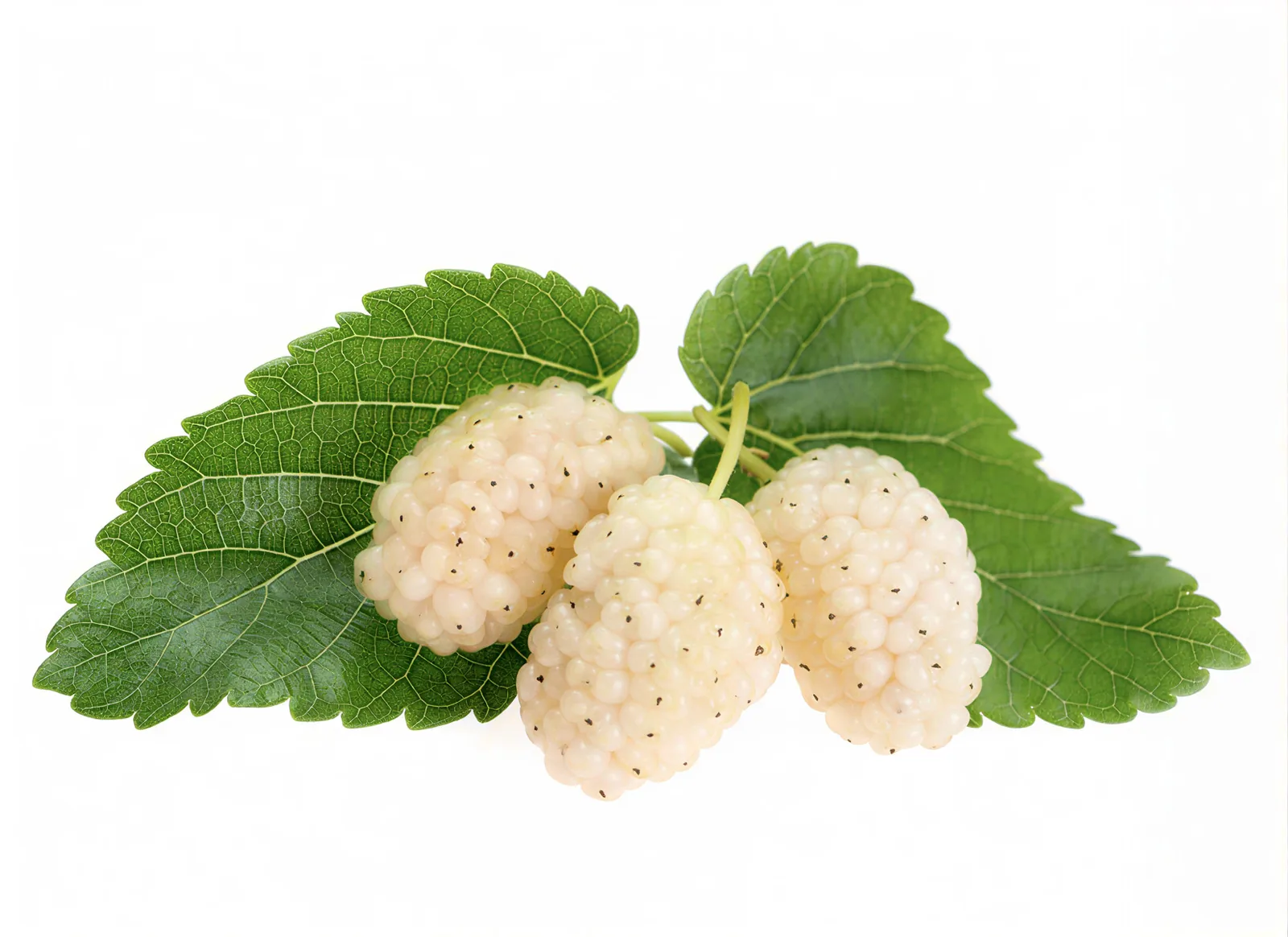
Mulberry1
Mulberry trees of the genus Morus in the Moraceae family have been widely cultivated in countries such as China, Korea, Japan, and Taiwan. In traditional Chinese medicine, white Mulberry is used to treat fever, promote urination, and lower blood pressure. In Korea and Japan, Mulberry leaves are used as an antidiabetic and to relieve alcohol-induced hangovers. Compared to red and black mulberries, the white Mulberry (Morus alba) has been the subject of more scientific studies. In addition to being rich in metabolites, the white Mulberry is widely available and is now extensively cultivated throughout Asia, Europe, and North America.2
Morphology of White Mulberry Leaves
Consisting of green, stalked, fragile leaves; leaf blades ranging from ovate to triangular in shape; leaf bases flat, rounded to pointed; margins crenate to bluntly toothed; tips tapering; pinnate venation with the midrib slightly prominent on the underside; underside rough and uneven; both surfaces slightly hairy.8
White Mulberry Leaf Active Compounds
White Mulberry leaves contain large amounts of flavonoids, steroids, triterpenes, amino acids, vitamins, and minerals.3 In addition, white Mulberry leaves contain 1-deoxynojirimycin (DNJ), which is considered the most active compound.2
Health Benefits of White Mulberry Leaves
Antidiabetic
The compound 1-deoxynojirimycin (DNJ) inhibits the activity of the alpha-glucosidase enzyme in the intestine. This enzyme plays a role in the digestion of carbohydrates so that they can be absorbed by the body. Inhibiting the activity of this enzyme delays the breakdown of carbohydrates, which in turn reduces glucose absorption and consequently suppresses the postprandial rise in blood glucose levels.3Literature Study
Subjects: 60 patients with Type 2 Diabetes Mellitus
Research dose: 300 mg Mulberry leaf extract, twice daily (total 600 mg/day)
Duration: 12 weeks
Results: A decrease in fasting insulin levels (meaning the body is using insulin more effectively). A decrease in malondialdehyde (MDA), a marker of oxidative damage, and an increase in HDL cholesterol (good cholesterol).5
Subjects: 50 healthy people aged 20-50 years
Research doses: 2.5 and 6 grams of water extract of Mulberry leaf (from 1.2 starting materials extracted with water with yield 13% (156 g) standardized active compound deoxynojirimycin (DNJ) 360mg/100g)
Duration: 1 day
Results: Consumption of leaf extract Mulberry caused a decrease in acute post-meal glucose levels at 30 and 60 minutes. Consumption of Mulberry leaf water extract resulted in improved post-meal glycemic control in healthy subjects.3
Reduce blood fat
White mulberry leaves can help lower blood fat levels. This effect occurs because the active compounds in white mulberry leaves can increase the activity of receptors that remove bad cholesterol (LDL) and reduce the activity of the enzyme HMG-CoA reductase, which plays a role in producing cholesterol in the body.2
Literature Study
There are two clinical studies using white Mulberry leaves to lower blood fat levels:
Subject: 382 hypercholesterolemia patients
Dosage: In the form of extract 200mg and 840 mg/day
Duration:6 - 16 weeks
Results: There was a decrease in blood lipid levels, such as triglycerides (TG), LDL-C, and total cholesterol.2
Safety
Mulberry is included in the list of specific natural ingredients in combination formulations indicated to help alleviate symptoms of diabetes in accordance with PerBPOM No. 25 of 2023.7 In a subacute study on rats administered 7.5 g/kg of mulberry leaf extract per day, no significant changes were observed in blood, organs, or biochemical functions.6
Keywords:White Mulberry; Morus alba; Antidiabetic; Blood lipids; Anti-cholesterol; Diabetes; Diuretic
References
Image: en.wikipedia.org
Ramadhansyah R, Thadeus MS, Muktamiroh H, Hardini N. The Therapeutic Effects of West Indian Elm (Guazuma ulmifolia) Leaf Extract on Coronary Artery Atherosclerosis in Hypercholesterolemic Wistar Rats. J. Food Nutrition. 2023; 18(2): 109-116. doi: https://doi.org/10.25182/jgp.2023.18.2.109-116.
Ministry of Health of the Republic of Indonesia.Regulation of the Minister of Health of the Republic of Indonesia Number 6 of 2016 concerning the Formulary of Original Indonesian Herbal Medicines. Ministry of Health of the Republic of Indonesia; 2016.