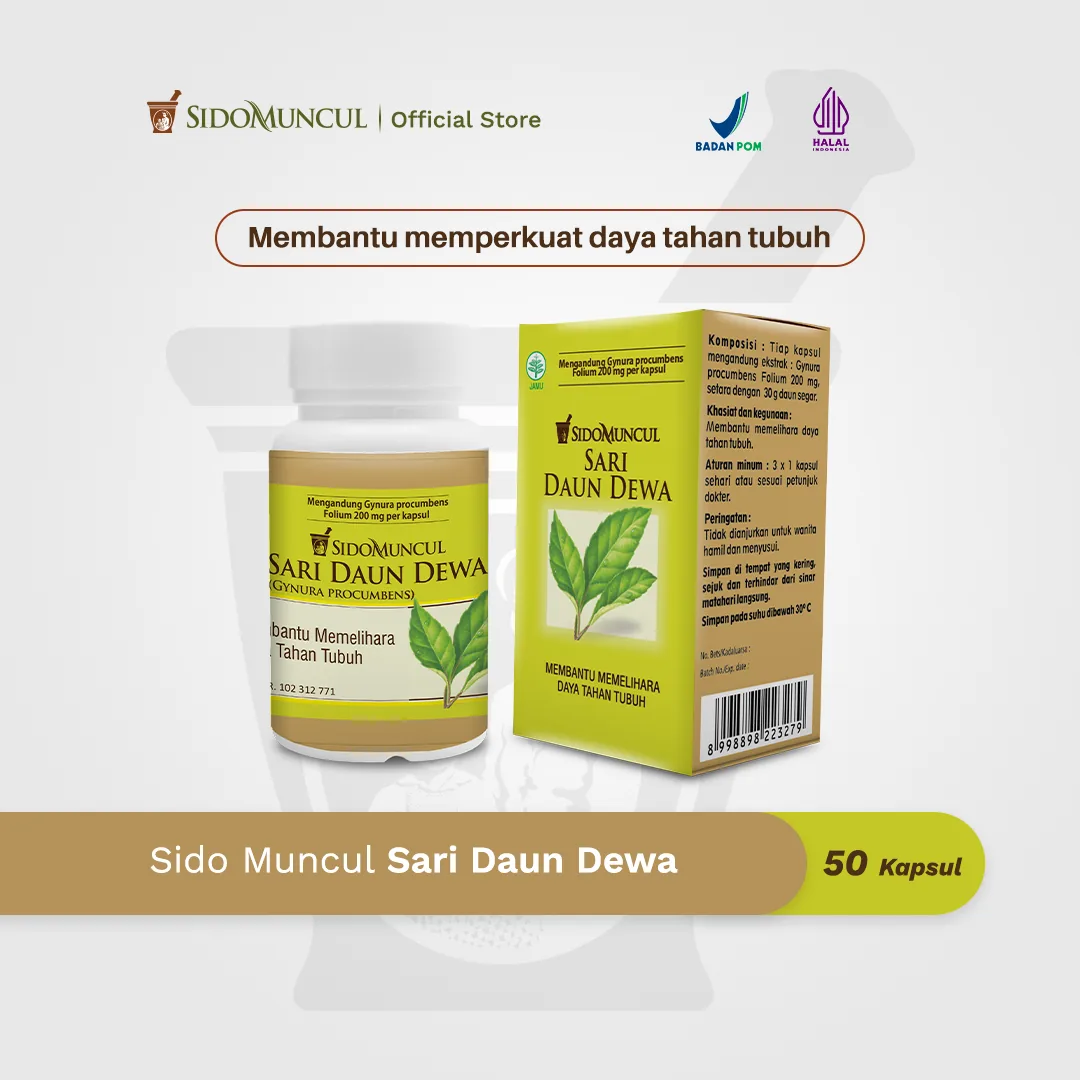
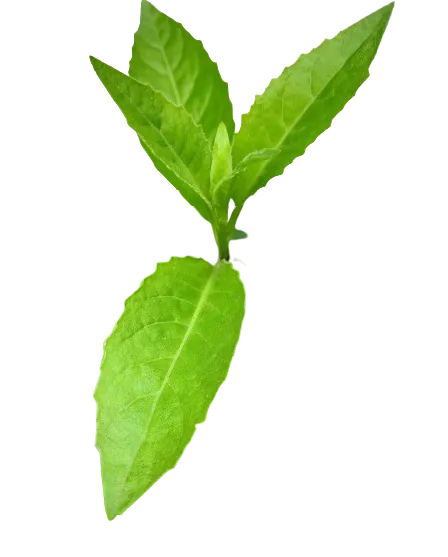
Dewa Leaves1
Dewa leaves, also commonly known as Sambung Nyawa leaves or Gynura procumbens folium, are a plant widely used in Asian countries, particularly China, Thailand, Indonesia, Malaysia, and Vietnam.1 In Java, Dewa leaves are traditionally used in herbal baths to treat rheumatism, while dried leaves that have been ground and mixed with oil are applied topically to various skin conditions.5 Dewa leaves have been extensively studied, particularly for their role in boosting immunity due to the plant’s activity as an immunomodulator.1
Morphology of Dewa Leaves
Dewa leaf is a perennial herb that is either trailing or slightly climbing, with dense foliage that is either glabrous or sparsely hairy. The leaves are oval to narrowly oval in shape and vary greatly in size (3–10 cm × 0.5–3 cm); the undersides of the leaves are slightly purple, and the leaves on the lower part of the stem are petiolate, while those on the upper part may or may not be petiolate.5
Dewa Leaves Active Compounds
Dewa leaves contain phytochemical compounds, including flavonoids, saponins, quercetin, kaempferol, rutin, astragalin, and myristicin. Their various pharmacological effects and biological properties are primarily attributed to their flavonoid content.3
Health Benefits of Dewa Leaves
In the literature, Daun Dewa is known to have a wide range of pharmacological effects, including anti-inflammatory and antioxidant properties. These anti-inflammatory and antioxidant effects are closely linked to the immune system.2
Literature Study:
Subjects: 25 white mice divided into groups
Research dose: Gynura procumbens leaves 75 mg/kg body weight, 150 mg/kg body weight, 300 mg/kg body weight.
Duration: 7 days orally
Results: Administration of Gynura procumbens leaf extract increased antibody titers, which rose with increasing doses, and significantly increased total leukocyte count and the percentage of leukocytes.3
Safety
Based on Formularium Ramuan Obat Tradisional Indonesia (Decree of the Indonesian Minister of Health No. HK.01.07/MENKES/187/2017), there have been no reports of side effects of Dewa Leaf reported, based on PMK No. 16 of 2016 concerning the Indonesian Original Herbal Medicine Formulary, the oral LD50 of Daun Dewa extract in mice is 5.56 g/kg body weight. In another study, it was proven that Daun Dewa extract did not cause acute toxicity or mortality in healthy test animals.4
Keywords: Gynura procumbens; Daun Dewa; Anti-inflammatory; Maintains Immunity; Rheumatoid.
References
Tan JN, Mohd Saffian S, Buang F, et al. Antioxidant and Anti-Inflammatory Effects of Genus Gynura: A Systematic Review. Front Pharmacol. 2020;11:504624. doi:10.3389/fphar.2020.504624.
Tan HL, Chan KG, Pusparajah P, Lee LH, Goh BH.Gynura procumbens: An Overview of the Biological Activities. Front Pharmacol. 2016;7:52. doi:10.3389/fphar.2016.00052.
Mou, Kanzil & Dash, Pritesh. A Comprehensive Review on Gynura procumbens Leaves. International Journal of Pharmacognosy. 2016; 3(4): 167-174. doi: 10.13040/IJPSR.0975-8232.IJP.3.
Yusoff WS, Johari AS, Kamarudin E, Mastuki MF, Abu MN, Safarudin Z. Effects of ethanol extracts ofGynura procumbens on in-vivo phagocytosis of wistar albino rats. Journal of Technology (Sciences & Engineering). 2016; 78(6-7).
Ng LY, Yap SF. Gynura procumbens (Lour.) Merr. In: Lemmens RHMJ, Bunyapraphatsara N, eds. Plant Resources of South-East Asia No 12(3): Medicinal and Poisonous Plants 3. PROSEA Foundation; 2003. Accessed April 9, 2026. https://prota4u.org/prosea.